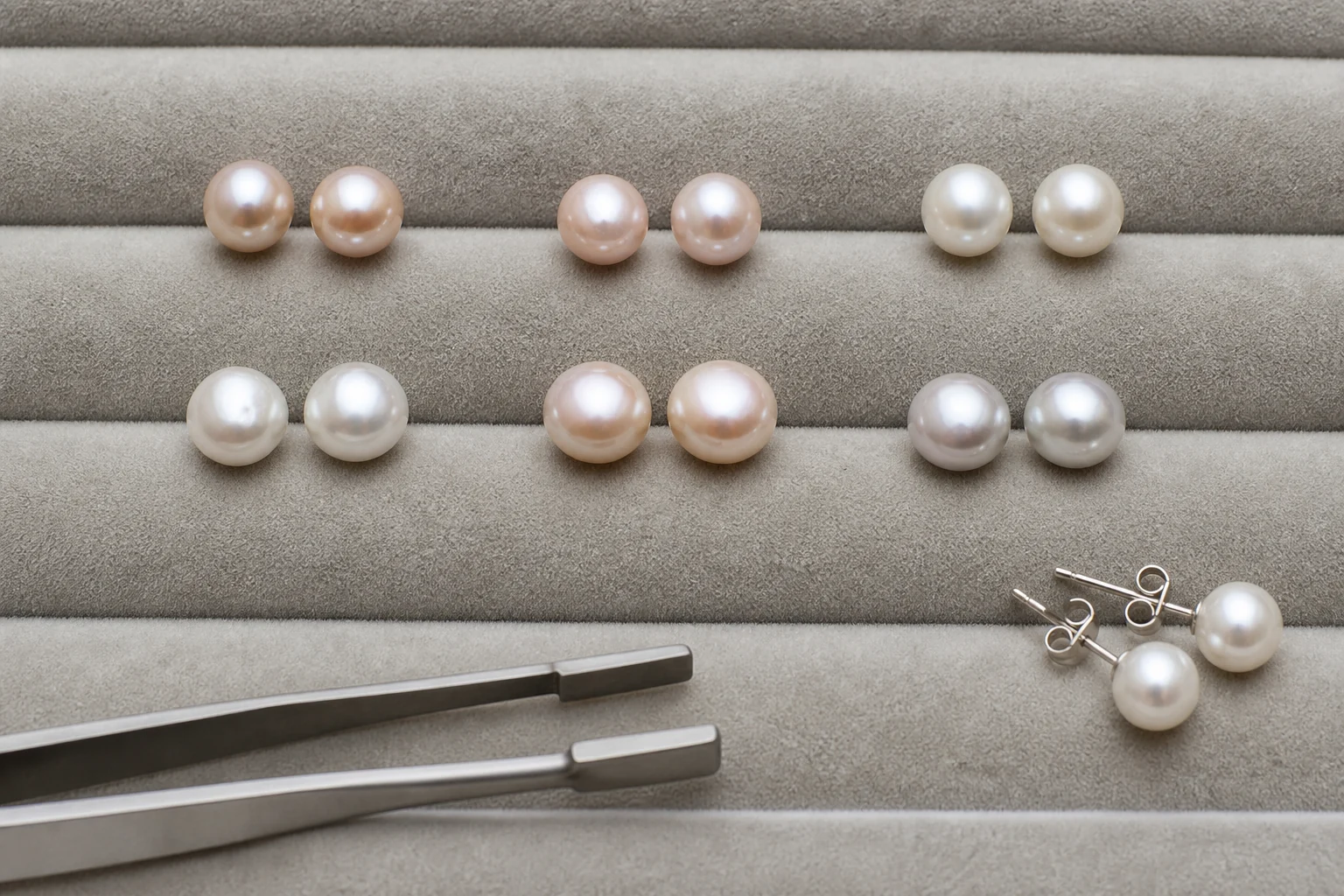
Start with the earring architecture
Define whether the product is a stud, drop, hoop attachment, hook design or another controlled construction. Record the pearl size, shape, drilling style, intended front profile and target finished weight. A post-and-back system that suits a small round stud may not suit a larger baroque drop. The attachment area must fit the pearl without forcing the drill hole or exposing avoidable adhesive and metal from the intended viewing angles.
Review the complete pair on the approved display or fit reference. Check how the pearl sits relative to the post, how the back clears the pearl and whether the design hangs in the intended direction. For drop earrings, control link orientation and movement. For studs, control the post axis and setting position. The technical drawing should show front, side and back views when one view cannot communicate these relationships. Record the finished pair weight and key dimensions when they are important to product positioning or packaging fit, using the agreed measurement method.
Specify posts and attachment surfaces
Record post length, diameter, tip shape, any groove position and the attachment pad or cup dimensions. Name the base metal and finish using supported documentation. If the post is inserted into a half-drilled pearl, specify hole diameter and depth, post fit, seating position and acceptable gap. If a cup or pad supports the pearl, define how much metal may remain visible from the front and side.
Attachment method is part of the controlled design. Identify the approved adhesive or mechanical method by code, surface-preparation instruction and curing process where relevant. Do not infer bond performance from appearance alone. Development should evaluate the complete sample, and production records should prevent an unapproved adhesive or post finish from being substituted without review.
Choose an earring back as a matched system
Butterfly or friction backs are common, but they vary in dimensions, spring behavior, metal and hole geometry. Bullet, disc-supported and other backs create different profiles and support. A screw-back system requires matched threading and a controlled operating method. Silicone or mixed-material backs need their own material and fit specification. The buyer should approve the exact post-and-back combination rather than buying each part independently by a generic name.
Check engagement, removal, alignment and visible finish on the assembled earring. The back should reach its intended position without scraping away finish, deforming the post or remaining unexpectedly loose. At the same time, do not specify an arbitrary tightness that makes the product impractical. If a quantitative retention requirement is necessary, develop a validated method for the specific component system and use calibrated equipment.
Control hooks, hoops, chains and jump rings
Drop earrings can include hooks, hoops, chains, pins and multiple jump rings. List every component in the bill of materials with dimensions, metal, finish and orientation. Specify whether rings are open, soldered or otherwise secured according to the approved construction. Show the intended movement and front-facing direction, particularly when a baroque pearl or decorative element has one preferred face.
Inspect connection points for gaps, deformation, sharp edges and inconsistent finish. Confirm that the pearl does not strike an abrasive component during normal movement defined by the development test. A catalog photograph of a hook cannot control the assembled drop length, balance or pair orientation. Use a dimensioned drawing and an approved physical pair for production.
Write truthful metal and product claims
The product description should distinguish cultured freshwater pearls from imitation materials and should represent metal content and treatments truthfully. The FTC Jewelry Guides address claims about pearls and precious-metal content in the United States. Destination markets may impose additional requirements, so buyers should identify the applicable market and obtain qualified review rather than treating one generic certificate as universal approval.
Keep component documents traceable to the production lot. A metal declaration or test report should identify the tested material or component sufficiently to connect it to the earring being sold. Do not extend a report for one post or finish to an unverified substitute. If a component changes, review the label, product page, packaging and test plan before approving the revision.
Inspect pairs, function and workmanship
Earrings are purchased as a pair, so inspect matching as well as individual workmanship. Compare pearl size, shape, color, luster, profile, drilling and setting position. Confirm post parallelism or the approved angle, consistent finished drop length, mirrored orientation where required, and the correct back in each pack. Use neutral light and a repeatable view rather than judging pairs from different photographs.
Define defect classes before production. Important examples include detached pearl, cracked or badly chipped drill area, back that does not engage, sharp edge, wrong metal or finish, bent post, open connector, visible excess adhesive, mismatched pair or incorrect packaging. Link inspection to the current drawing, bill of materials and approval sample, and retain records that can support root-cause review if a field problem occurs. When rework is allowed, define the approved method, reinspection scope and traceability so repaired units do not bypass the original functional and visual criteria.
Procurement decision table
| System | Design use | Key controls |
|---|---|---|
| Post with friction back | Classic pearl studs | Post dimensions, groove, back fit, pad and attachment |
| Post with disc-supported back | Larger studs needing a broader support profile | Disc size, orientation, post match and visible profile |
| Screw post and back | Designs intentionally developed for threaded operation | Matched thread, finish, engagement and user instructions |
| Hook or ear wire | Drop earrings | Wire dimensions, closure concept, link orientation and drop length |
| Hoop or chain assembly | Moving or multi-component designs | Every connector, gap, movement path and pair symmetry |
Buyer checklist
- [ ] Define earring style, pearl size, shape and drilling.
- [ ] Dimension posts, pads, cups, hooks, rings and backs.
- [ ] Identify base metal, finish and supported product claims.
- [ ] Control adhesive or mechanical attachment instructions.
- [ ] Approve the exact post-and-back combination.
- [ ] Check pair matching, orientation and finished dimensions.
- [ ] List critical, functional and cosmetic defects.
- [ ] Review documentation whenever a finding changes.
Frequently asked questions
Are all butterfly earring backs interchangeable?
No. Dimensions, spring behavior, hole geometry, metal and finish vary. Approve the exact back with the exact post used in production.
What should be specified for a pearl stud post?
Specify length, diameter, tip, groove, base metal, finish, pad or cup, attachment method, orientation, approved back and finished-product checks.
How are pearl earring pairs inspected?
Compare pearl quality factors, profile, setting position, post alignment, finished dimensions, orientation, back function and packaging under consistent conditions.
Can one metal report cover every earring finding?
Only when the report and traceability genuinely cover those components and production materials. A changed supplier, alloy or finish may require new review or testing.
Related freshwater pearl buying guides
Sources and official references
Use these primary references together with the written product specification and destination-market professional advice.
Turn this guide into a purchase-ready specification
Send Tony Ren your target pearl product, quality tolerances, quantity, packaging and destination. We can discuss current-batch evidence, samples and a clearly scoped quotation.