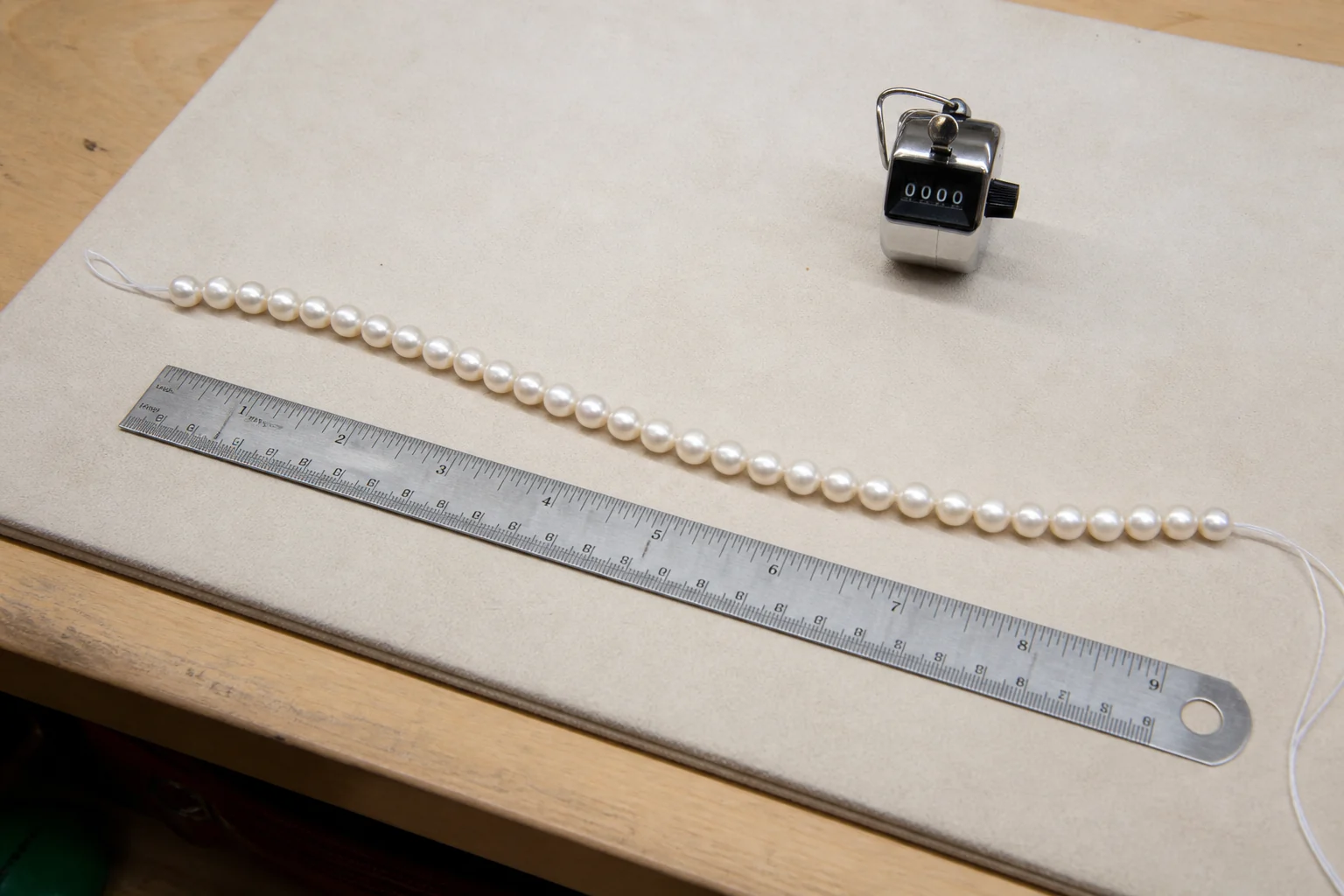
Define the commercial unit before measuring
Begin by identifying the item and unit. A loose pearl strand supplied on temporary thread is not measured in the same way as a finished knotted necklace with a clasp. State whether the purchase unit is one strand, one necklace, a pair, a packet or a stated weight. Give the buyer SKU, supplier item code, nominal size range, color, shape and approved sample reference so that the measurement record cannot be separated from the product it describes.
Write the nominal length and the included components in plain language. For example, a temporary strand can be specified from the first pearl surface to the last pearl surface, excluding exposed thread and tags. A finished necklace can be measured end to end in its closed, relaxed condition, including the clasp. The exact method matters more than using a familiar label such as 16 inch, because two teams may otherwise include different parts of the product.
Measure pearl diameter consistently
Pearl size is normally communicated in millimeters, but irregular shapes require a defined measuring direction. For a near-round pearl, measure the diameter perpendicular to the drill hole unless the approved drawing says otherwise. For oval, rice, drop or baroque pearls, record the relevant width and length dimensions instead of reducing the pearl to one ambiguous number. Use a suitable caliper with clean contact surfaces and enough care to avoid scratching or compressing the pearl.
A range such as 7 to 8 mm should not be treated as a complete acceptance rule. The purchase order should say whether every measured pearl must remain within the range, whether a small number of documented outliers is allowed, and how many pearls are checked per strand. It should also state whether dimensions are rounded for commercial naming or recorded at the tool's displayed resolution. Do not claim greater precision than the tool, method and natural surface permit.
Control strand length without forcing false precision
Lay the strand on a flat, clean surface without stretching the thread or forcing curved sections straight. Keep the pearls touching in the condition defined by the specification. For temporary strands, slack thread, knots and end loops can change the apparent length, so the procedure should state how these are positioned. For finished knotted jewelry, measure the relaxed product as worn and record whether clasp hardware is part of the stated finished length.
Set tolerances from product function, construction and the approved sample rather than copying a universal number. A strand intended to be cut into components may tolerate a different overall length than a finished necklace sold at a labeled size. Knot size, pearl count, drill orientation and clasp geometry all influence the result. If finished length is critical, control both the overall length and the inputs that create it, including count, layout and construction.
Use an inspection sample that represents the lot
A single handpicked strand cannot demonstrate lot consistency. Define the production lot, select pieces without allowing the inspector to choose only the best cartons, and record which cartons and positions were sampled. The sample size should follow the buyer's agreed inspection plan and risk level. When a formal acceptance-sampling standard is used, identify the standard, edition, inspection level and acceptance rule instead of writing only the letters AQL.
Record measurements in a table linked to the lot number and product revision. Useful fields include strand number, nominal length, actual length, minimum and maximum pearl diameter, observed outliers and disposition. Photographs can show the setup and unusual results, but they do not replace dimensional records. Retain the approved sample and a copy of the measurement method for repeat orders so later batches are compared on the same basis.
Separate natural variation from manufacturing errors
Cultured freshwater pearls are biologically formed materials, so small differences in contour and surface are expected. A dimensional tolerance should describe the acceptable commercial range without converting inherent variation into an automatic defect. At the same time, inherent biological variation does not excuse avoidable errors such as a wrong size mix, an incorrect pearl count, an off-spec finished length or a substituted layout that was never approved.
Use defect descriptions that identify the failed requirement. Examples include a pearl below the agreed minimum width, a finished necklace shorter than the labeled range, or an abrupt size jump where the layout requires a gradual transition. This language is more useful than general comments such as too small or inconsistent. When a result is borderline, compare it with the written tolerance and approved boundary sample rather than relying on memory or screen images.
Release the specification with change control
Place the method, tolerance and sample reference in the purchase order, controlled specification or drawing. Give the document a revision number and require the supplier acknowledgment to repeat it. If the buyer changes the nominal length, pearl range, count or clasp after sampling, issue a written revision that states which quantities are affected. Do not allow a new chat message to silently override the document used by production and inspection.
For reorders, ask the supplier to confirm whether the same measurement method, tooling and construction remain in use. Compare the new lot with retained records and representative samples, not only with a marketing photograph. If a harvest or component change requires a wider range, approve that change before production and update the customer-facing description when necessary. A controlled method makes natural variation manageable and keeps quote, sample, production and inspection aligned.
Procurement decision table
| Item | Method to define | Risk if omitted |
|---|---|---|
| Temporary strand length | First pearl surface to last pearl surface; state treatment of loops and slack | Different teams report different lengths |
| Finished necklace length | Closed and relaxed; state whether clasp is included | Label size and inspected size do not match |
| Pearl diameter | Millimeters and measuring direction relative to the drill hole | Irregular pearls are measured on different axes |
| Outliers | Allowed count, sampling scope and disposition | A nominal range is enforced inconsistently |
| Inspection record | Lot, sample selection, tool and revision | Results cannot support a reorder or claim |
Buyer checklist
- [ ] Identify the SKU, lot, pearl type, shape, color and approved sample.
- [ ] State whether the item is a temporary strand or finished necklace.
- [ ] Define exactly which endpoints are included in strand length.
- [ ] Define pearl dimensions and the measuring direction.
- [ ] Specify the tool, sampling plan and allowed outliers.
- [ ] Control count, layout, knots and clasp when they affect length.
- [ ] Record results against the current document revision.
- [ ] Keep representative records and samples for repeat orders.
Frequently asked questions
Does a 16-inch pearl strand have to measure exactly 16 inches?
The order should define the nominal length, included components and acceptable tolerance. Cultured pearls and construction create variation, so an exact value without a method or tolerance is not a complete specification.
Should the clasp be included when measuring a pearl necklace?
It can be included, but the specification must say so. Finished necklaces are often measured end to end in the closed, relaxed condition, while temporary strands require a different endpoint rule.
How should irregular pearls be measured?
Record the relevant width and length axes and their relationship to the drill hole or design. One diameter is often insufficient for oval, rice, drop or baroque pearls.
Can photographs prove strand length and pearl size?
Photographs can document the setup and show a ruler or caliper display, but a lot-linked measurement record and agreed sampling method are needed for reliable acceptance.
Related freshwater pearl buying guides
Sources and official references
Use these primary references together with the written product specification and destination-market professional advice.
Turn this guide into a purchase-ready specification
Send Tony Ren your target pearl product, quality tolerances, quantity, packaging and destination. We can discuss current-batch evidence, samples and a clearly scoped quotation.