Translate product risks into a test plan
Begin with the design, bill of materials, intended use and foreseeable failure modes. A knotted necklace may need checks for clasp operation, end connections, knots, drape and finished length. Stud earrings may need post alignment, back engagement and pearl attachment checks. A multi-component drop earring adds connector closure and movement. Testing should focus on the functions that make the specific product usable and saleable, not on a generic list applied without judgment.
Create a risk review before setting methods. Consider the severity of a failure, how likely it is to occur and whether production inspection can detect it. A detached component, nonfunctioning clasp or sharp edge may deserve different control from a minor visual variation. Regulatory and retailer requirements can add mandatory tests; buyers should obtain qualified advice for their destinations instead of assuming an internal factory check is a universal compliance program.
Define every method and acceptance rule
A test name alone is not reproducible. State whether the check is visual, manual or instrumented; identify sample condition, direction, fixture, equipment, rate, duration, repetitions and pass or fail rule where relevant. If force is measured, use suitable calibrated equipment and record the unit. If operation is cycled, define one complete cycle and the condition inspected afterward. Photograph the setup when words do not fully communicate it.
Set criteria from product requirements, development evidence and applicable obligations. Do not invent a numeric threshold simply because it appears objective. A value appropriate for one clasp or setting may damage another legitimate design or fail to control the real risk. Validate the method with approved samples and known defects where possible, then place the current method under revision control.
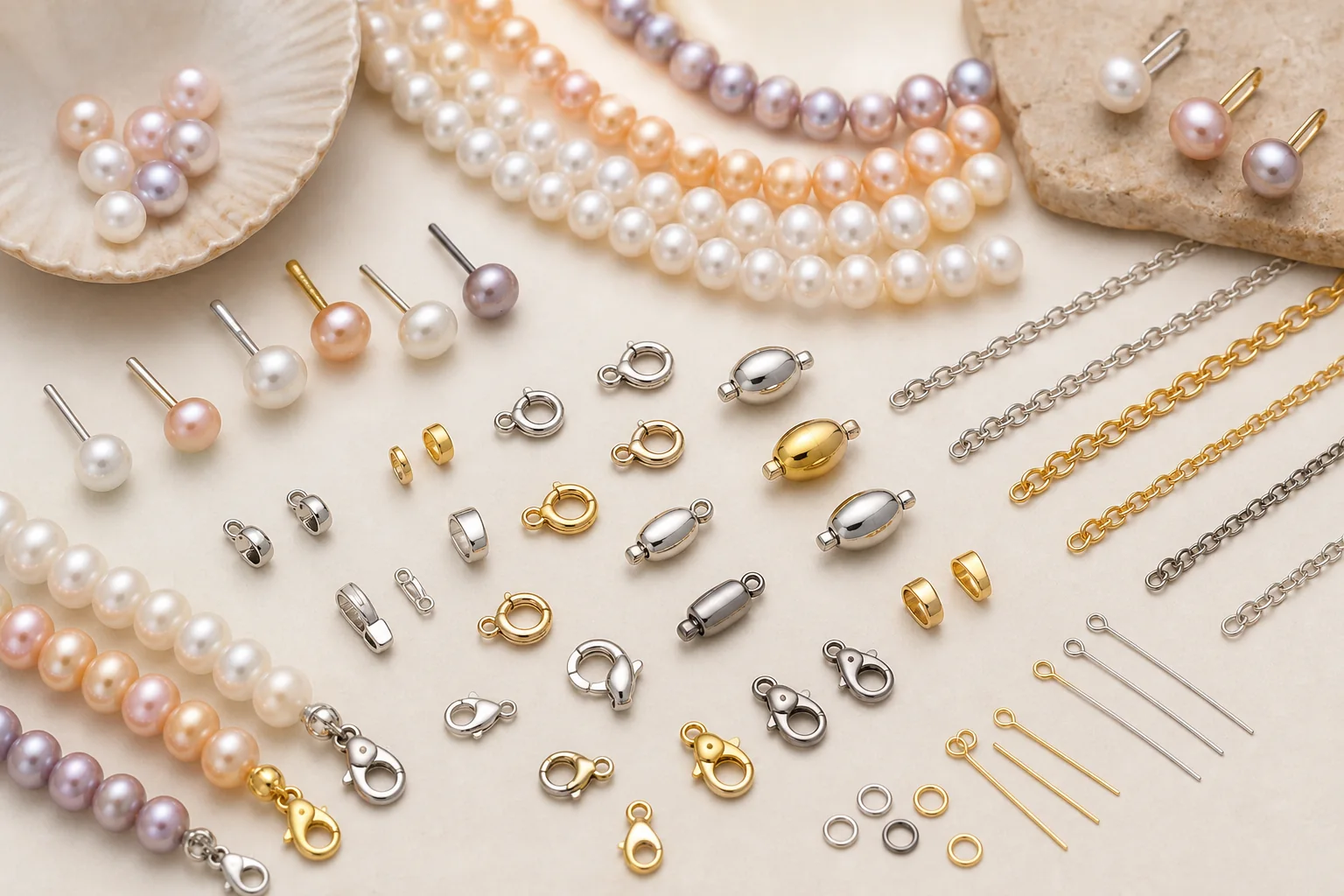
Check closures, posts and moving findings
Operate clasps through the complete intended motion and confirm engagement, release, alignment and absence of sharp or unfinished areas. Inspect the clasp on the assembled product because end connections and necklace weight affect behavior. For earring posts and backs, confirm that the approved back engages the post, reaches the intended position and can be removed using the defined method without visible deformation or unexpected finish damage.
For hooks, hoops, chains, extenders and decorative moving parts, inspect connector gaps, orientation and movement paths. Confirm that parts do not bind or abrade pearls in the agreed handling procedure. Multi-strand clasps should keep the strand order and spacing intended by the drawing. Record the actual component codes because a visually similar substitute can perform differently.
Check stringing, knots and pearl attachments
Review thread, cord or wire against the approved bill of materials. Inspect knots for consistency and correct placement, wire for kinks or exposed ends, and transitions for fraying or sharp contact. Measure finished length after the product has settled under the agreed condition. Development handling or flex checks can reveal weak workmanship, but their meaning depends on a defined method and should not be described as proof of lifetime performance.
For half-drilled or mounted pearls, examine seating, orientation, visible gaps, excess adhesive and damage around the drill area. If an attachment test is required, define the direction and fixture so the result is repeatable and relevant to the design. A test can confirm the sampled assembly under its conditions; it does not prove that every uninspected item or future substitute is identical. Process control and production inspection remain necessary.
Include finish, packaging and post-test inspection
Functional testing should not ignore appearance. After operation or handling, inspect metal finish, pearl surface, stringing, connectors and moving interfaces for changes defined as unacceptable. Pearls are comparatively soft and require appropriate care, so avoid test conditions or cleaning methods that are unrelated to intended use and would damage the material without providing a useful product decision.
Packaging can influence function by allowing tangling, crushing or component movement. Evaluate the packed product through the buyer's approved packaging procedure and inspect it after unpacking. Confirm that posts are protected, strands are restrained without harmful pressure and clasps do not rub directly against pearls. Packaging tests should identify the package revision, product configuration, carton arrangement and acceptance criteria.
Separate development validation from lot inspection
Development testing asks whether the design and specification are suitable. It may use more detailed or destructive procedures on prototypes and should be completed before bulk release. Production inspection asks whether a particular lot conforms to the approved design. It uses a defined lot, representative sample or full check according to the inspection plan. Passing one stage does not remove the need for the other.
ISO 2859-1 describes sampling schemes indexed by acceptance quality limit for lot-by-lot inspection, but the buyer must select and document how a standard is applied. Do not write AQL 2.5 as a complete plan. Identify the standard and edition, lot, inspection level, sample selection, defect classes and acceptance or rejection numbers. Keep raw results, failures, rework and reinspection traceable to the product revision and production lot.
Procurement decision table
| Construction | Primary checks | Evidence to retain |
|---|---|---|
| Knotted necklace | Clasp, end connection, knots, drape and finished length | Sample ID, method, measurements and failure photos |
| Wire-strung necklace | Crimps, guards, kinks, connector gaps and clasp | BOM codes, setup, results and post-test condition |
| Pearl stud earrings | Post alignment, back engagement and pearl attachment | Pair ID, component codes, operation and attachment results |
| Drop or hoop earrings | Links, orientation, movement, hooks or closure | Drawing revision, cycle record and connector inspection |
| Packed finished jewelry | Restraint, abrasion, crushing, tangling and post protection | Packaging revision, configuration and unpacking record |
Buyer checklist
- [ ] Identify the product revision, BOM and approved sample.
- [ ] Map failure modes to product-specific functional checks.
- [ ] Define method, equipment, condition and acceptance criteria.
- [ ] Validate numeric limits instead of copying generic values.
- [ ] Check closures, connectors, stringing and pearl attachments.
- [ ] Inspect appearance and dimensions after each relevant test.
- [ ] Separate development validation from lot inspection.
- [ ] Retain raw results, failures, rework and reinspection records.
Frequently asked questions
What functional tests should pearl jewelry receive?
Tests should follow the design risks and can include closure operation, post-and-back engagement, connector integrity, knot or stringing checks, pearl attachment, dimensions and packaging performance.
Is AQL a functional test?
No. AQL is part of an acceptance-sampling approach. The underlying inspection methods and defect criteria must still be defined for the product.
Can one pull-test value be used for every pearl product?
No. Method, direction, construction and product risk differ. Numeric criteria should be developed and validated for the specific design and applicable requirements.
Does a passed sample prove the entire production lot is durable?
No. It supports a decision about the tested sample under stated conditions. Production controls, lot inspection, traceability and truthful claims are still required.
Related freshwater pearl buying guides
Sources and official references
Use these primary references together with the written product specification and destination-market professional advice.
Turn this guide into a purchase-ready specification
Send Tony Ren your target pearl product, quality tolerances, quantity, packaging and destination. We can discuss current-batch evidence, samples and a clearly scoped quotation.