Treat the sales unit and product specification as separate data
A unit says how quantity is transacted; it does not say what quality is acceptable. One piece could be a loose pearl, a stud, a bracelet or a clasped necklace. One strand could be temporary stringing or a finished product. One gram could include pearls of very different diameters and counts. Every line item therefore needs both a quantity unit and a product definition covering pearl material, size, shape, color, luster, surface tolerance, drilling, matching and any findings or construction.
Create a controlled unit code in supplier and buyer systems rather than relying on free text. Distinguish pc for one loose or finished item, pair for two intentionally matched items, strand for one specified length and format, g for grams of stated material, and momme where the trade uses it. Do not use set unless the set contents are itemized. State whether the quoted quantity is exact, minimum, approximate or subject to a documented tolerance.
Use pieces and pairs when count drives the business decision
Pieces work well for center pearls, calibrated loose pearls, pendants and finished jewelry when each unit is individually countable. Define whether one earring is one piece and whether posts, backs or cards are included. For loose goods sold by piece, record the accepted size interval and sorting rule because two pieces at the same nominal diameter may differ in shape, drilling or quality. Packing records should show pieces per inner pack and total pieces per carton.
Pairs are a quality-controlled unit, not merely two pieces divided by two. State the matching criteria for size, face-up shape, bodycolor, overtone, luster, surface and drilling or fitting orientation. Confirm whether the pair is loose, mounted or supplied with backs and cards. Receiving should count complete pairs and record unmatched singles separately. A supplier should not replace a rejected member with a visually different pearl simply to restore the numeric pair count.
Define strands by usable length, format and expected count range
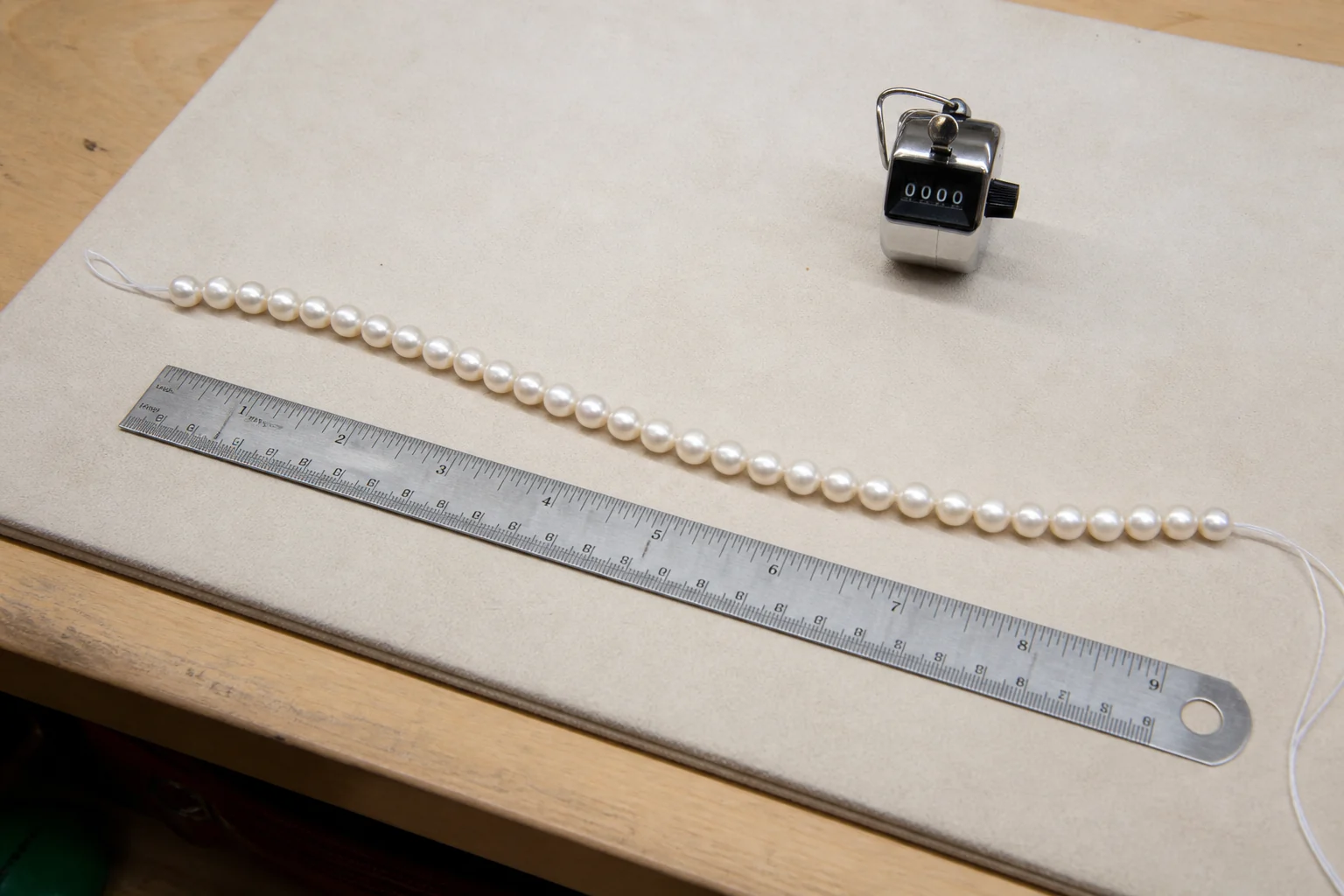
A strand quantity is incomplete without length and construction. State whether the pearls are temporarily strung, knotted or assembled as finished jewelry; give the usable pearl section and overall finished length where relevant; and identify clasp, thread, knot or spacer allowances. Nominal terms such as hank, rope, matinee or sixteen-inch strand can vary by market and use. Put the measurement in millimeters or centimeters and explain how it is taken under normal tension.
Pearls per strand depend on average diameter, shape, drill orientation, knots, spacers and usable length. Do not promise a universal count from diameter alone. If count affects costing or assembly, approve a count range and record the actual pack count. For graduated strands, specify the size sequence and center position. For baroque pearls, use length plus representative count and weight records because irregular shapes can make two visually similar strands differ substantially.
Use grams and momme for bulk mass with a clear conversion basis
CIBJO lists gram and momme among units used for cultured pearls and defines one momme as 3.75 grams. When converting, multiply momme by 3.75 to obtain grams, or divide grams by 3.75 to obtain momme. Keep enough decimal precision for the transaction and state the rounding rule. The gram is an SI unit of mass; use the symbol g with a space after the number in formal product data where practical.
Mass-based trading needs a net-content definition. State whether the figure includes temporary thread, bags, tags, clasps, mixed findings, moisture-control materials or packaging. For loose pearls, use a tared container and calibrated scale appropriate to the quantity and tolerance. Record gross, tare and net mass. CIBJO notes that pearl weight may change over time, so minor differences should be assessed against the agreed method and tolerance rather than treated automatically as shortage.
Write purchase orders that can be converted without ambiguity
Select one commercial unit as the controlling quantity and show any secondary unit as reference. A line might order a number of temporary strands, each with a stated length and pearl size, while recording expected grams for logistics only. Another line might order net momme with an approximate piece-count range. If both values appear, state which governs invoicing and shortage decisions. Otherwise a harmless variation in count can conflict with a correct delivered mass.
Include ordered quantity, unit code, conversion factor, rounding, quantity tolerance, pack unit and label format. Require the invoice and packing list to use the same controlling unit, while customs documentation follows destination requirements. When a supplier quotes in a local unit, preserve the original value and record the approved conversion rather than repeatedly converting rounded numbers. One source value prevents cumulative discrepancies between quotation, purchase order, payment, packing and receiving.
Reconcile count, mass and condition at receiving
Receiving staff should verify carton and inner-pack counts before opening a representative sample. Count pieces, pairs or strands using the approved pack structure; weigh bulk goods with the agreed tare procedure; and measure strand length or selected pearl sizes according to the specification. Do not mix lots before discrepancies are resolved. Photograph labels and scale displays, and retain the original packing record so a unit-conversion issue can be separated from an actual physical shortage.
Investigate differences systematically. Check unit interpretation, decimal placement, rounding, tare, broken strands, loose units, mixed sizes and whether sample pieces were invoiced. Reconcile the controlling commercial unit first, then use secondary measures as reasonableness checks. Record accepted variation, credit, replacement or rejection through the agreed claim process. Feed repeated conversion or labeling errors back into supplier master data and templates so the same ambiguity does not recur on later orders.
Procurement decision table
| Unit | Best fit | Must specify | Receiving control |
|---|---|---|---|
| Piece | Loose center pearl or one finished item | Item definition, size and included components | Count by inner pack and inspect attributes |
| Pair | Matched earrings or intentionally matched loose pearls | Pair-matching criteria and included findings | Count complete pairs; segregate singles |
| Strand | Temporary stringing or finished necklace | Usable length, construction, size and count range | Count strands and sample length/count |
| Gram | Bulk loose or temporarily strung cultured pearls | Net-mass basis, tare, tolerance and scale method | Verify calibrated net mass |
| Momme | Trade lots quoted by cultured-pearl mass | Conversion of 1 momme = 3.75 g and rounding | Preserve source value and verify net mass |
Buyer checklist
- [ ] Assign one controlling commercial unit to every purchase-order line.
- [ ] Define the product attributes separately from its quantity unit.
- [ ] State exactly what one piece, pair, strand or set contains.
- [ ] Specify strand length, format, count range and measurement method.
- [ ] Use 1 momme = 3.75 g and document rounding when conversion is needed.
- [ ] Define gross, tare and net mass and list excluded packing materials.
- [ ] Keep quotation, invoice, packing list and receiving unit codes consistent.
- [ ] Reconcile the controlling unit before using secondary measures as checks.
Frequently asked questions
How many grams are in one momme?
CIBJO defines one momme of pearl weight as 3.75 grams. State that factor and the rounding rule whenever both units appear in a transaction.
How many pearls are in a strand?
It varies with usable length, pearl diameter, shape, drill orientation, knots and spacers. Specify a measured length and an approved count range for the exact product.
Does one pair always mean two identical pearls?
It means two units intended to be matched, but cultured pearls will not be literally identical. Define acceptable matching for size, shape, color, luster, surface and orientation.
Should a wholesale order be controlled by both count and weight?
One unit should govern the commercial quantity. A second measure can be a useful check, but the purchase order must explain which value controls invoicing and shortage decisions.
Related freshwater pearl buying guides
Sources and official references
Use these primary references together with the written product specification and destination-market professional advice.
Turn this guide into a purchase-ready specification
Send Tony Ren your target pearl product, quality tolerances, quantity, packaging and destination. We can discuss current-batch evidence, samples and a clearly scoped quotation.