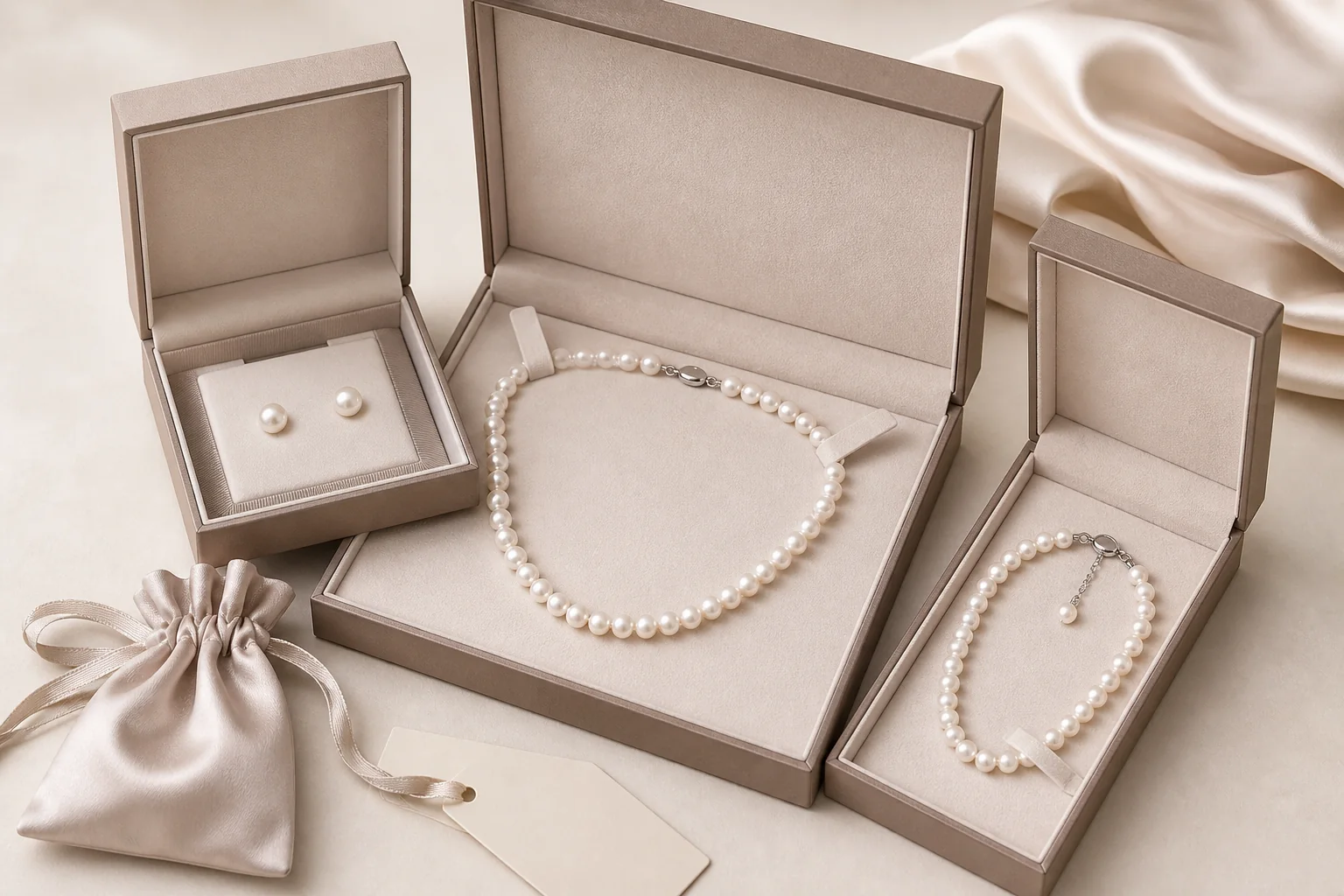
Map how tangles and damage occur
A necklace can tangle when its clasp or extender moves through a loop, when a long loose section crosses itself, or when several pieces share one cavity. Pearl surfaces can also rub against metal parts, rough inserts or neighboring jewelry. Begin with the complete construction: finished length, strand flexibility, clasp, extender, pendant, knotting and set components. Observe how the item behaves when the pack is tilted and inverted before choosing a tray or pouch.
Separate product risks from presentation preferences. A dramatic loose coil may photograph well but arrive knotted; a tight bend may hold the necklace in place but stress thread or create a set in flexible material. Identify unacceptable outcomes such as a clasp trapped under pearls, sharp post contact, crossed multi-strand rows, scuffed surfaces or a customer needing tools to release the product. These outcomes guide retention design and testing.
Create a controlled necklace path
Use slots, covered ties, soft tabs or shaped channels to hold the necklace at several points. Retainers should be wide and smooth enough not to cut thread, compress knots or mark pearl surfaces. The path should avoid abrupt bends and make the front center easy to identify. Record every retention point on an assembly drawing and photograph the approved pack from front, back and closed positions.
Long necklaces may require a figure-eight or layered path, but crossings should be separated and intentional. Multi-strand necklaces need row order preserved. If a pouch is used, consider an internal card or individual sleeves rather than relying on the pouch alone to prevent movement. Test removal: a pack that prevents tangling but requires pulling hard on the strand creates another risk.
Isolate clasps, extenders and metal components
Secure the clasp near its designated end position and keep it from swinging across pearls. Retain extender chains so they cannot wrap around the strand, and cover sharp or heavy charms. For magnetic or decorative clasps, ensure the mechanism does not attach to unintended metal packaging parts. A soft sleeve, separate recess or covered tab can isolate components when validated with the actual design.
Sets require separate positions for earrings, bracelets or pendants. Earring posts and backs should not face the necklace. Do not allow a metal care-card staple or exposed wire tie to contact pearls. List all packaging contact materials and confirm that dyes, coatings, adhesives and printed surfaces are suitable for the intended product and storage conditions through supplier evidence and testing where appropriate.
Build the retail pack and shipping parcel together
The presentation box or card is only one layer. Place the closed retail unit in the actual mailer or carton with intended void fill and orientation. A rigid box may move inside an oversized parcel, while a soft pouch can be compressed by other goods. Define inner pack quantity, separators and carton arrangement for wholesale shipments. The approved packaging specification should cover the entire hierarchy.
Select handling tests for the known distribution environment. ISTA guidance emphasizes understanding hazards and choosing an appropriate procedure. Development checks can include drops, vibration, compression and atmospheric conditions when relevant, but do not claim certification unless the exact procedure, laboratory and pass criteria support it. Open the pack after testing and record both packaging and necklace condition.
Control labels, inserts and pack-out accuracy
A protected necklace can still be unsellable if the wrong size, color or SKU label is applied. Link the product, packaging version, care card, barcode and carton mark in the bill of materials. Define label position and scan representative barcodes against item data. If the necklace has an extender, state the labeled length range accurately. For a set, list every included component and quantity.
Make assembly verification simple. A printed silhouette, locator marks or a clear work instruction can show where the clasp and front center belong. Inspectors should be able to count components without dismantling the pack unnecessarily. Control artwork revisions and remove obsolete labels from the line. When packaging is supplied by another vendor, name the party responsible for final fit and pack-out approval.
Inspect arrival condition and improve the pack
Sample packed units from the production lot and check necklace identity, retention points, component isolation, label accuracy and closed presentation. Invert and handle units using the agreed check, then open them consistently. Record tangles, crossings, displaced clasps, scuffs, crushed corners and difficult removal. Photographs should show the unopened pack and the first-open condition before staff rearrange the necklace.
Collect warehouse and customer feedback by failure mode. If tangling occurs, identify whether the cause is missing retention, a loose extender, excessive void space, assembly error or distribution damage. Revise the drawing and retest rather than adding random ties. Keep sustainability claims separate from performance: reduced material is valuable only when the pack still protects the necklace and claims are supported.
Procurement decision table
| Risk | Packaging control | Verification |
|---|---|---|
| Strand loops through itself | Retain at several points on a controlled path | Tilt, invert and inspect first-open condition |
| Clasp scratches pearls | Isolate clasp in sleeve or recess | Check contact after handling test |
| Extender wraps around strand | Secure chain and end charm separately | Open pack without rearranging product |
| Multi-strand rows cross | Use row-specific channels or separators | Compare row order with approved photo |
| Wrong packed SKU | Controlled label, barcode and pack-out instruction | Scan and reconcile product data |
Buyer checklist
- [ ] Map strand, clasp, extender and accessory movement risks.
- [ ] Draw a controlled necklace path with non-damaging retention points.
- [ ] Isolate metal parts from cultured-pearl surfaces.
- [ ] Preserve row order for multi-strand and set configurations.
- [ ] Test the retail pack inside the actual shipping parcel.
- [ ] Control SKU, barcode, care card and packaging revisions.
- [ ] Inspect unopened and first-open condition on sampled units.
- [ ] Use failure data to revise and retest the pack-out.
Frequently asked questions
Is a jewelry pouch enough to stop a pearl necklace from tangling?
Not always. Long strands, extenders and clasps can still move inside a pouch; an internal card, sleeve or controlled path may be needed.
How many points should hold a necklace in its box?
There is no universal number. Use enough smooth retention points to control the actual length and components without tight bends, thread damage or difficult removal.
Should the clasp touch the pearls in the package?
Avoid uncontrolled metal-to-pearl contact where practical. Retain or sleeve the clasp and extender, then validate the complete pack under handling.
Does a drop test prove packaging is suitable?
One check is not universal proof. Choose procedures for the distribution environment and evaluate the complete sequence, product condition and documented acceptance criteria.
Related pearl necklace buying guides
Sources and official references
Use these primary references together with the written product specification and destination-market professional advice.
Turn this guide into a purchase-ready necklace specification
Send Tony Ren your target pearl necklace design, dimensions, quality tolerances, quantity, packaging and destination. We can discuss current-batch evidence, samples and a clearly scoped quotation.