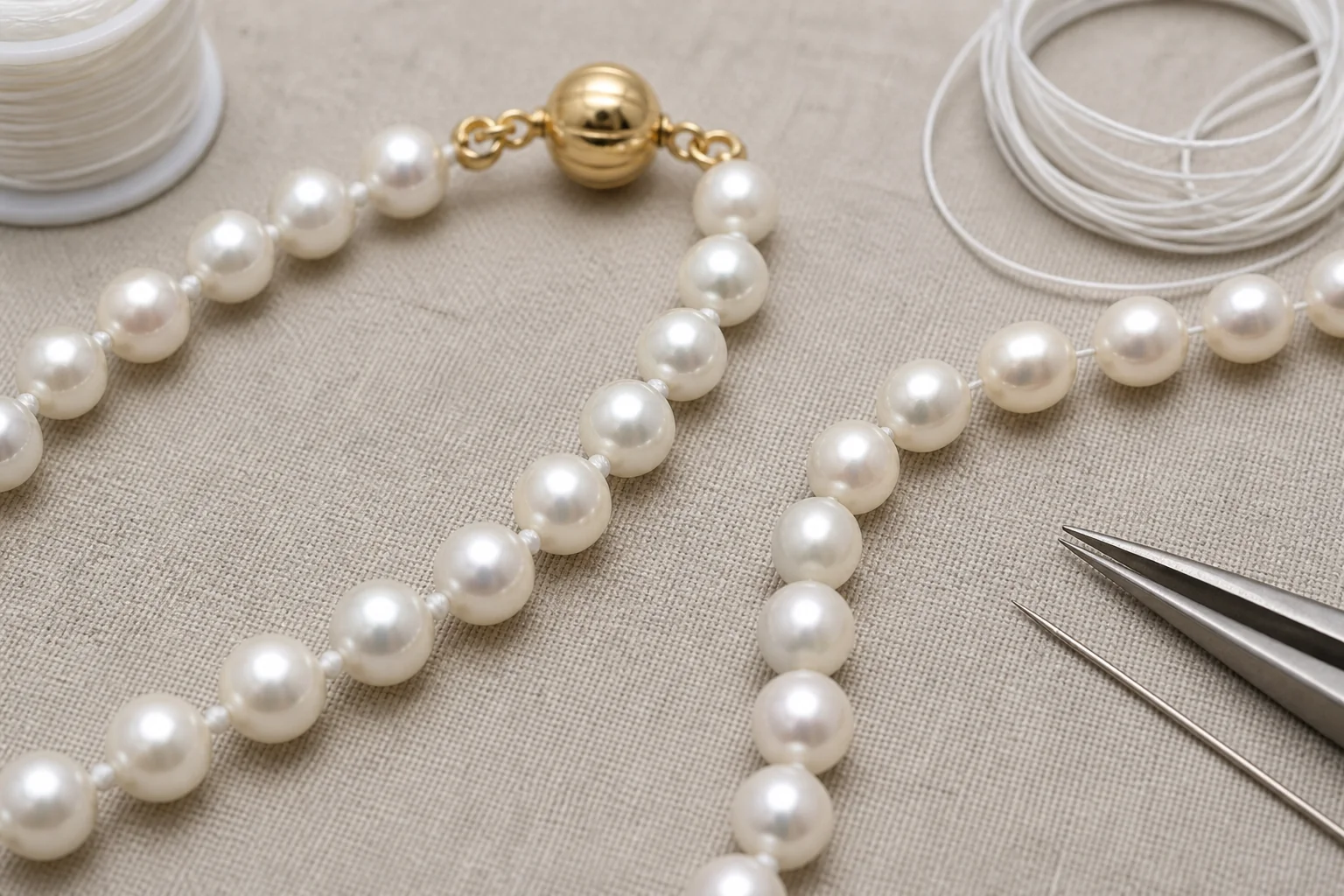
Decide what the knots must achieve
Knotting is both a construction method and a visible design choice. When placed between every pearl, knots can limit movement, reduce direct rubbing and restrict loss to pearls near a break; station knotting provides less retention. Knots also add length, change flexibility and create a particular visual rhythm. Before asking a factory to knot a necklace, state whether the product goal is classic fine knotting, a visibly spaced craft look, occasional station knots or another approved construction. A photograph alone does not explain which function matters most.
Connect the knotting decision to the pearl and intended customer. Small pearls with narrow holes may need a different thread build and knot scale than large baroque pearls. A soft everyday necklace, a structured collar and a long layered strand may require different tension. Record the pearl size range, hole diameter, strand length, clasp weight and intended drape so production does not solve each variable independently. If the buyer changes the pearl lot or clasp, the knotting sample should be reviewed again.
Specify thread, knot location and visual boundaries
Name the approved stringing material, color and construction rather than writing only thread. State whether every pearl is knotted, whether the first and last sections use a different method, and how the thread is secured at the clasp. For a fully knotted necklace, define the expected relationship between the knot and drill hole: the knot should sit close enough to control movement without being forced into the hole or creating a large decorative lump unless that look is intentional.
Use boundary samples for knot appearance. Photograph an acceptable knot, an unacceptably loose knot, an oversized knot and any allowed variation caused by irregular pearl contours. A numeric diameter can support the record, but it should not be the only rule because soft thread compresses and pearl surfaces are uneven. Specify unacceptable exposed tails, fraying, discoloration, adhesive residue and sharp wire or finishing material at the ends. These examples help inspectors apply the same standard across shifts and reorders.
Control spacing and finished tension
The necklace should be neither so loose that visible thread gaps open during normal handling nor so tight that it kinks, twists or arches away from the body. Define a simple handling check: lay the necklace in a relaxed curve, lift it at agreed points and observe whether the pearls articulate smoothly. Inspect local gaps around knots and at the clasp transition. For irregular pearls, judge the apparent gap from the nearest contact surfaces rather than from theoretical pearl centers.
Tension may change after construction as thread settles and knots compact. Agree when finished length and drape are measured, such as after a defined resting period under ordinary room conditions. Avoid inventing a universal settling time; validate it with the selected thread, pearl weight and assembly process. If pre-stretching or conditioning is part of production, document the method. The approved sample should have passed through the same process expected for bulk units.
Manage length added by knots
Every knot occupies space, so pearl count alone does not determine finished necklace length. The specification should state the target finished length, measurement endpoints, pearl count or layout, knotting pattern and whether the clasp is included. When the factory quotes from a loose temporary strand, it should calculate or sample the additional length created by knots and end finishing instead of assuming that the finished piece will match the temporary strand.
If length is critical to a labeled size, control both the outcome and the inputs. Record the allowed finished-length range and inspect it together with knot spacing and pearl count. A necklace that meets length only because it has excessive thread gaps is not conforming. Conversely, a piece should not be rejected solely because inherent pearl-size variation changes the exact number of knots within a controlled layout. The purchase order should state which attributes have priority when small adjustments are needed.
Inspect the complete necklace rather than isolated knots
Begin inspection with identity, length, clasp and overall appearance, then review knot consistency along the complete strand. Rotate the necklace under neutral light and look for sudden spacing changes, crossed thread, pinched pearls, exposed tails, fraying and uneven transitions at the clasp. Gently articulate the strand using an agreed method; do not apply improvised pull forces that could damage saleable products or imply a test strength that has not been validated.
Use a sampling plan tied to the production lot and risk. Record which units and cartons were inspected, the approved specification revision and defect counts. Classify a construction condition by effect: an insecure end knot may create failure risk, while a small visual difference inside an approved boundary may be minor or conforming. Retain examples of recurring defects and review trends, because repeated loose sections can indicate inconsistent technique, thread preparation or operator training.
Plan wear, care and repair information
Pearls and stringing materials can be affected by moisture, cosmetics, abrasion and storage conditions. Product care should be compatible with both the cultured pearls and the thread. Avoid telling customers to soak a knotted necklace or use a chemical cleaner unless the complete construction has been evaluated for that method. Store the necklace supported and untangled, and make clear that care guidance reduces avoidable wear but does not create an unlimited durability promise.
Set an after-sales position before launch. Decide whether the brand offers inspection, restringing or paid repair, what evidence is required and which damage is outside normal coverage. Keep the approved thread, clasp code, pearl specification and construction record so a repair can be assessed consistently. For repeat programs, review returned units and customer comments to identify whether knot loosening is isolated damage or a production pattern that requires corrective action.
Procurement decision table
| Control point | What to define | Inspection evidence |
|---|---|---|
| Knot pattern | Every pearl, selected stations or approved design map | Full-necklace comparison with drawing |
| Knot appearance | Boundary samples for size, tails and residue | Close-up views under consistent light |
| Tension | Relaxed drape with no harmful gaps or kinks | Handling check on sampled finished units |
| Finished length | Endpoints, clasp inclusion and tolerance | Lot-linked measurement record |
| End finishing | Thread path, protection and securing method | Clasp-area inspection and approved sample |
Buyer checklist
- [ ] Identify pearl size, hole range, necklace length and clasp weight.
- [ ] Name the approved thread material, build and color.
- [ ] Map where knots are required and how end sections differ.
- [ ] Approve visual boundaries for knot size, gaps, tails and residue.
- [ ] Define the relaxed-drape and articulation check.
- [ ] Measure finished length after the validated settling process.
- [ ] Inspect sampled units against the current specification revision.
- [ ] Keep construction records for reorders, care and repair decisions.
Frequently asked questions
Should every cultured pearl in a necklace be knotted?
Not always. Full knotting, station knotting and unknotted constructions serve different designs and costs. The specification should state the intended pattern and its functional purpose.
How tight should a knotted pearl necklace be?
Tight enough to avoid uncontrolled visible gaps, but not so tight that the necklace kinks or loses smooth articulation. Approve the result on the actual pearl, thread and clasp combination.
Can every knot be exactly the same size?
Soft thread and biologically formed pearls create controlled variation. Use visual boundaries and function checks rather than claiming impossible mathematical identity.
When should finished necklace length be measured?
Use a documented point after the validated construction and settling process. The method should state the endpoints and whether the clasp is included.
Related pearl necklace buying guides
Sources and official references
Use these primary references together with the written product specification and destination-market professional advice.
Turn this guide into a purchase-ready necklace specification
Send Tony Ren your target pearl necklace design, dimensions, quality tolerances, quantity, packaging and destination. We can discuss current-batch evidence, samples and a clearly scoped quotation.