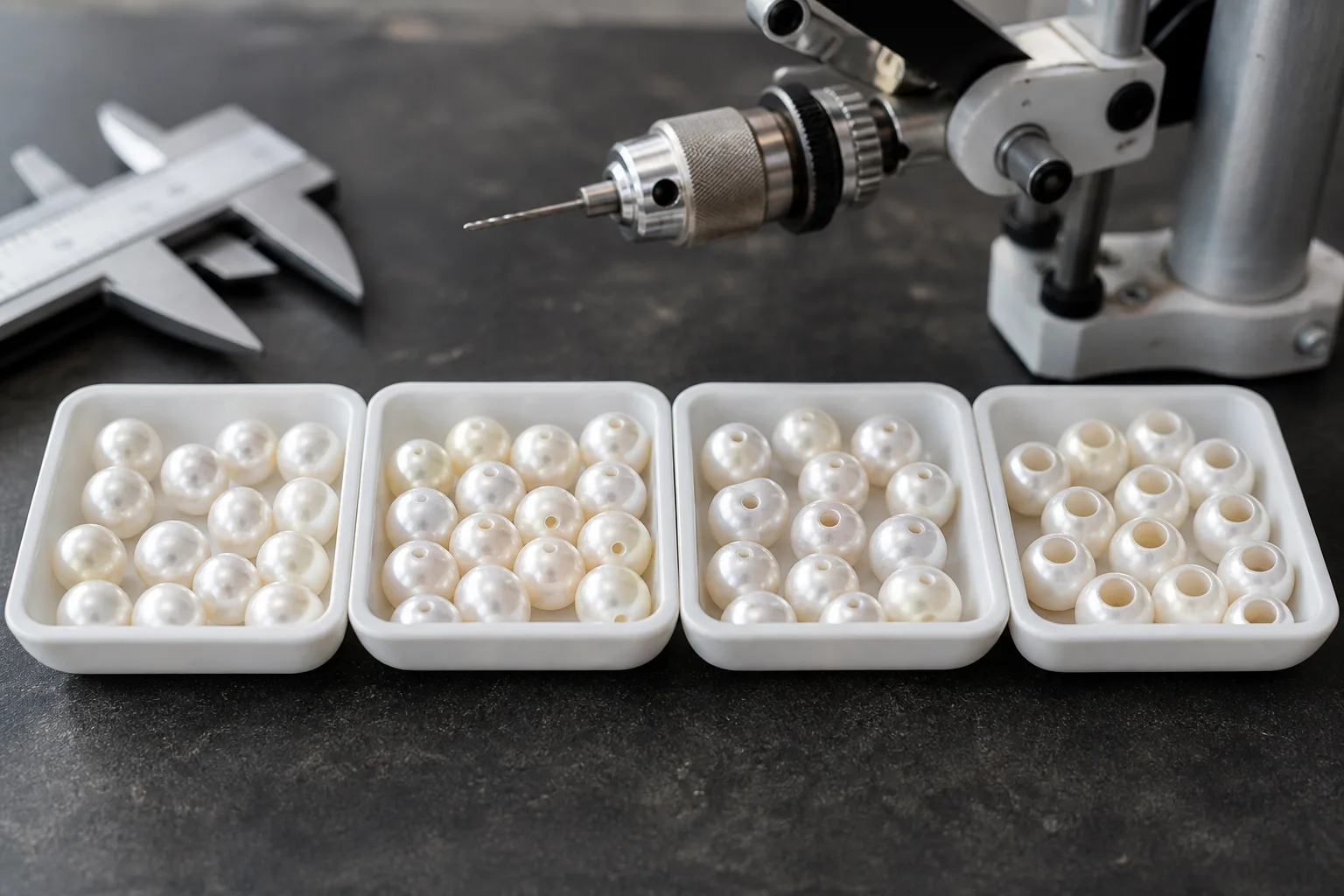
Four common drilling options
Undrilled pearls preserve flexibility for later setting. Fully drilled pearls suit necklaces, bracelets and bead work. Half-drilled pearls are used with cup-and-peg findings for studs, rings and pendants. Large-hole pearls support thicker cord, leather and modular designs, but removing more nacre requires careful process control.
How to choose a hole diameter
The hole must fit the actual thread, wire or peg with enough clearance for assembly but not so much that the pearl moves visibly. Send a component sample or technical drawing when fit is critical. Do not rely on standard hole because equipment, thread construction and plating thickness vary.
Position and direction matter
Centered drilling improves alignment in uniform strands. For baroque pearls, the selected drilling axis controls how the shape hangs and which surface faces forward. Half-drilled pairs require consistent depth and direction so posts align. Mark orientation on approval photos when the pearl has a preferred face.
Inspecting drill-hole quality
Check both entry and exit points for chips, flaking, dark residue and excessive opening. Confirm that the hole is continuous and free of obstruction. Test a production sample with the final thread or finding. A hole that looks acceptable in a photo can still be too tight, off-center or weak at the edge.
Information to send for a quote
Specify pearl shape, size, quantity, hole type, hole diameter, drilling axis, intended use and component material. Add close-up requirements for approval and define whether drilling is included in the unit price. For mixed sizes, list each size and hole requirement separately.
Frequently asked questions
What is a half-drilled pearl used for?
It is normally bonded to a peg or post for stud earrings, rings and pendants.
Can an existing pearl hole be enlarged?
Often yes, but feasibility depends on pearl size, current hole, nacre condition and required final diameter.
Why do pearl holes chip?
Common causes include worn tools, unsuitable speed, poor support or drilling too close to a weak surface area.
Related freshwater pearl guides
Need current pearl samples or a quote?
Send Tony your required pearl type, size, color, quality, quantity and intended use. We can share current batch photos, sample options and wholesale pricing.
Ask Tony on WhatsAppRelated 2026 procurement guides
Continue with these practical specification, quality-control and order-planning resources.