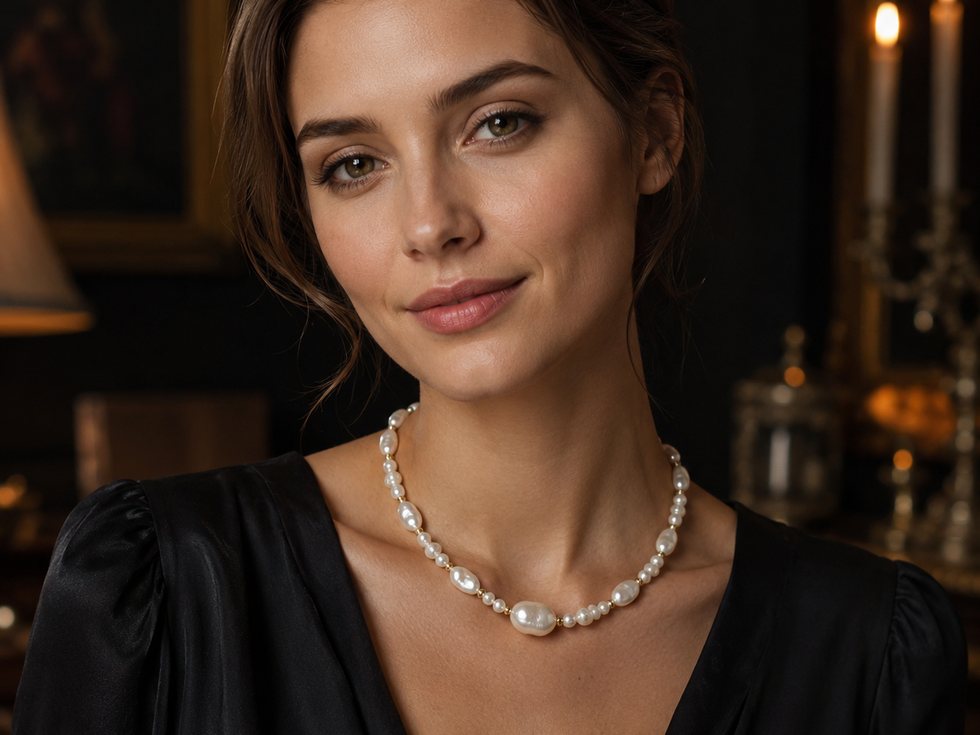
Define the palette and use accurate pearl terminology
Start the specification with named palette groups such as cream, peach, lavender and silver-gray, then attach physical references or calibrated sample photographs to each group. A color word by itself is too broad for production because two lots described as lavender may differ in tone, saturation, overtone and luster. Define the commercial mood of the necklace, but translate that mood into observable acceptance criteria. Record colors that are intentionally included, colors that are permitted only as transitions and colors that must be excluded from the layout.
Describe the goods as cultured freshwater pearls when that is what the supplier provides. Cultured pearls grow in living mollusks following human intervention; natural pearls form without intentional human initiation, so natural pearl is not a synonym for cultured freshwater pearl. Also separate origin terminology from color terminology. A cultured pearl may display an untreated color, but that does not make it a natural pearl. The purchase order should identify known treatments and require the supplier to disclose dyeing, irradiation or other relevant color alteration according to the applicable market rules.
Separate bodycolor, overtone, orient and luster
GIA describes bodycolor as the dominant overall color and overtone as a translucent color over the bodycolor; some pearls also show orient, an iridescent effect at or just below the surface. These observations should not be collapsed into a single vendor color name. A pearl with a cream bodycolor and pink overtone can read differently from a peach pearl even when both appear warm in a quick photograph. Build the palette by comparing the actual pearls face-up, at a slight angle and after rotation, because an overtone may become more or less visible as the viewing angle changes.
Luster and surface condition affect perceived color as strongly as hue selection. A high-luster pearl can create a bright highlight that appears almost white, while a lower-luster pearl of the same bodycolor may look flatter or darker. Decide whether each color group must share a similar luster range or whether contrast is an intentional design feature. Keep shape and diameter within defined ranges as well, since a larger or strongly baroque pearl carries more visual mass and can make one palette area look dominant even when its color is correct.
Create a position map and a repeatable sequence rule
Give the necklace a fixed viewing orientation before documenting the sequence. One practical convention is to place the clasp at the top, assign the center or focal pearl position zero and map outward toward the viewer's left and right. Label each position with a palette code, size band and any required shape or orientation. A mirrored layout, smooth gradient, repeating motif, controlled color block or deliberately irregular composition all need different rules. State the rule in words and show it in a numbered diagram so a new operator can rebuild the design without guessing.
For a repeating sequence, specify the motif, where the first complete repeat begins and how the pattern resolves near the clasp. For a gradient, define the order of color groups and the acceptable size of each transition step. For a controlled-random look, set minimum separation between strong accent colors, maximum cluster size and any protected focal zone. Random should describe the visual result, not an uncontrolled production method. Retain the final mapped sample because a loose tray photograph does not prove which pearl occupied each position in the finished necklace.
Balance transitions, focal zones and visual weight
Review color transitions at normal viewing distance before judging individual matches at close range. An abrupt change can be purposeful in a color-block design, but it looks like a sorting error inside a soft gradient. Mark the focal zone that will sit at the front of the neck and decide whether it should contain the lightest pearl, the darkest accent, the strongest overtone or a quieter bridge color. When the design is mirrored, balance perceived intensity rather than demanding that cultured pearls be visually identical; biological variation makes exact duplication unrealistic.
Color and physical scale should be assessed together. A dark pearl, a larger pearl and a highly irregular baroque pearl may each carry extra visual weight. Placing all three on one side can tilt the composition even if the palette codes are symmetrical. Rotate baroque pearls to review highlight direction and silhouette, then check the necklace hanging and on a form because gravity changes how adjacent surfaces face the viewer. Continue the layout through the end zones so the colors beside the clasp do not create an accidental unmatched pair when the necklace is worn.
Control lighting, treatment disclosure and photography
Approve color under a documented light source, background and viewing distance, and use the same setup for production inspection. Mixed daylight, warm room lighting and bright display lamps can shift the apparent relationship between cream, peach, lavender and gray. Allow a short adaptation period when moving between lighting conditions, keep strongly colored objects away from the inspection area and compare necklaces to the master at the same angle. A camera preview can support records, but automatic white balance and screen settings make it unsuitable as the only acceptance standard.
Keep treatment status attached to the palette and lot record. FTC guidance for the United States calls for cultured status to be made clear and identifies circumstances in which pearl treatments require disclosure, including effects on permanence, care or value. CIBJO guidance likewise distinguishes natural from cultured pearls and addresses treatment information and special care. Marketing images may be exposure-corrected for consistency, but they should not invent a hue or erase variation that buyers need to understand. Maintain separate files for commercial imagery and color-control photographs.
Inspect production and manage reorder variation
Inspect the completed necklace in its defined orientation and compare the whole sequence before checking individual positions. Verify palette codes, transition direction, repeat continuity, focal-zone placement, unexpected clusters and the relationship between color, size, shape and luster. Turn the necklace over and rotate it gently to detect pearls that change the balance when they move. Use a defect record that identifies the exact position, observed issue and proposed disposition; a note such as "wrong color" is too vague to guide rework or improve sorting.
Fresh cultured-pearl lots will not reproduce every shade indefinitely, so a reorder standard needs a managed substitution process. Keep a retained master necklace and representative loose references away from strong light, heat and chemicals, then compare them periodically for visible change. Before a new lot enters production, build a short pilot layout and ask the buyer to approve any palette shift or revised transition rule. Update the map, sample version and photography together. This protects visual consistency without promising an impossible exact shade match across biological materials and different harvests.
Procurement decision table
| Layout mode | Best use | Specification rule | Primary QC focus |
|---|---|---|---|
| Mirrored palette | Balanced front-facing designs | Map matching color groups outward from position zero | Perceived left-right intensity |
| Gradient | Soft movement from light to dark or hue to hue | Define ordered groups and maximum transition step | Abrupt jumps and reversals |
| Repeating motif | Graphic or collection-led patterns | State the motif, start point and clasp-end resolution | Missing, doubled or shifted repeats |
| Controlled random | Organic mixed-color appearance | Limit accent spacing, cluster size and protected zones | Unplanned concentration of one color |
| Color block | Deliberate high-contrast sections | Fix block boundaries and focal placement | Boundary position and block proportion |
Buyer checklist
- [ ] State cultured freshwater pearl identity and record relevant color treatments.
- [ ] Approve named palette groups with physical references and exclusion limits.
- [ ] Separate bodycolor, overtone, luster, size and shape observations.
- [ ] Define orientation, center reference and every position or sequence rule.
- [ ] Set transition, repeat, accent-separation and focal-zone requirements.
- [ ] Document neutral lighting, background, viewing distance and photo settings.
- [ ] Inspect the complete necklace for balance before judging single pearls.
- [ ] Retain a master sample and reapprove palette shifts for each reorder lot.
Frequently asked questions
Can a supplier follow a request for a random multicolor mix?
Not repeatably without more rules. Define the approved palette, accent separation, cluster limits, focal zone and excluded colors, then retain a mapped sample of the intended organic look.
Are bodycolor and overtone the same thing?
No. Bodycolor is the dominant overall color, while overtone is a translucent color visible over it. Evaluate both because pearls with similar bodycolor can look different in a necklace.
Does natural color mean the necklace contains natural pearls?
No. Natural pearl describes formation without intentional human initiation. A cultured freshwater pearl may have an untreated color, but it remains a cultured pearl and should be identified as such.
How should a buyer approve color for a reorder?
Compare a pilot from the current lot with a protected retained master under the documented lighting setup. Approve any palette or transition change and issue a revised map rather than relying on an old color name.
Related pearl necklace buying guides
Sources and official references
Use these primary references together with the written product specification and destination-market professional advice.
Turn this guide into a purchase-ready necklace specification
Send Tony Ren your target pearl necklace design, dimensions, quality tolerances, quantity, packaging and destination. We can discuss current-batch evidence, samples and a clearly scoped quotation.